
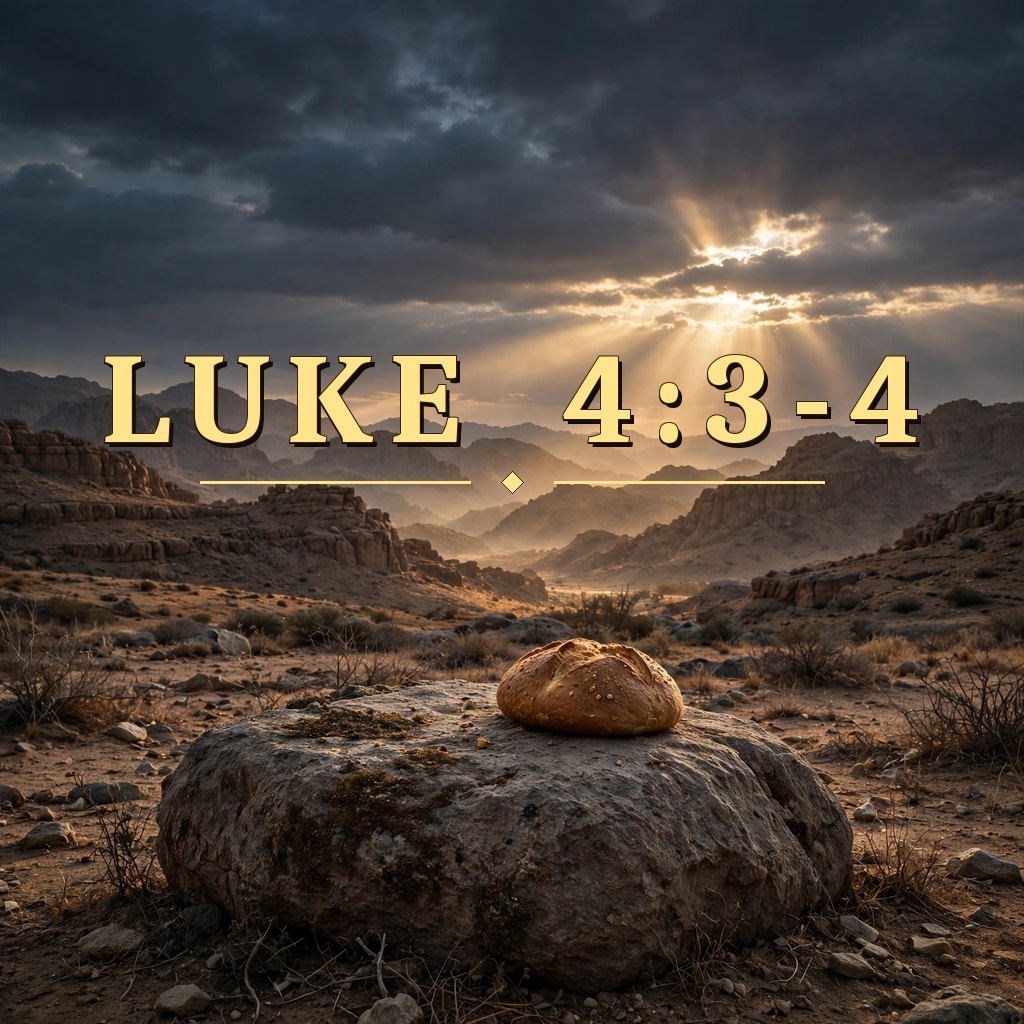
What happens when your physical needs become more important than your spiritual relationship with God? When Jesus Christ was tempted in the wilderness, Satan approached Him at a moment of extreme physical weakness. After fasting for forty days, Jesus was hungry, and the devil challenged Him to turn stones into bread. But Jesus’ response revealed a powerful spiritual truth: our lives depend on more than food, possessions, and the things we need to survive physically. Luke 4:3-4 teaches us about resisting temptation, trusting God’s provision, and understanding the importance of His Word. This passage reminds us that our greatest need is not physical satisfaction but a life grounded in obedience to God.
The Bible Verse – Luke 4:3-4 (KJV)
Luke 4:3-4 (KJV)
“And the devil said unto him, If thou be the Son of God, command this stone that it be made bread.
And Jesus answered him, saying, It is written, That man shall not live by bread alone, but by every word of God.”
These two verses reveal the first temptation Jesus faced in the wilderness. Satan attempted to use Jesus’ physical hunger to challenge His identity and tempt Him into acting outside the Father’s will.
Understanding the Meaning of Luke 4:3-4
The devil approached Jesus with a challenge: “If thou be the Son of God.” This was not simply a suggestion to satisfy hunger. Satan was attempting to use Jesus’ circumstances to tempt Him to act independently of the Father’s direction.
Jesus had the power to turn stones into bread. There was nothing inherently sinful about eating bread or satisfying hunger. The temptation was about how and why Jesus would use His power. Satan was encouraging Him to respond to physical need rather than remain obedient to God.
Jesus answered with Scripture, quoting Deuteronomy 8:3:
“Man shall not live by bread alone, but by every word that proceedeth out of the mouth of the LORD doth man live.”
This statement establishes an important distinction between physical and spiritual life.
Bread represents the physical necessities of life. We need food, water, shelter, and other provisions to survive. However, these things are not the foundation of our relationship with God. Our spiritual lives depend upon Him and His Word.
Jesus was not saying that physical needs are unimportant. He was demonstrating that obedience to God must never be sacrificed simply to satisfy a physical desire.
The central lesson is clear: God’s Word must have greater authority in our lives than our immediate wants, fears, or circumstances.
Biblical and Historical Context
Luke 4 takes place immediately after Jesus’ baptism. In Luke 3, Jesus is baptized by John, and the Holy Ghost descends upon Him. A voice from heaven declares:
“Thou art my beloved Son; in thee I am well pleased.” (Luke 3:22, KJV)
Following His baptism, Jesus is led by the Spirit into the wilderness, where He faces temptation from the devil.
Luke 4:2 tells us that Jesus fasted for forty days and was afterward hungry. This establishes the physical circumstances surrounding Satan’s first temptation.
The wilderness was a place of isolation and physical hardship. Jesus had gone without food for an extended period, making Satan’s suggestion particularly direct.
There is also an important connection to the history of Israel. In Deuteronomy 8:2-3, Moses reminded Israel how God humbled them in the wilderness and allowed them to experience hunger before providing manna.
God was teaching Israel that their survival depended upon Him, not merely upon physical food.
Jesus responds to Satan using that same Scripture. Where Israel had been tested in the wilderness, Jesus remained obedient.
The passage establishes Jesus as the faithful Son who would not abandon the Father’s will, even under extreme circumstances.
Applying This Scripture to Our Lives
Luke 4:3-4 challenges us to examine what controls our decisions.
We all experience moments when physical needs, financial pressures, personal desires, or difficult circumstances can influence our choices. Sometimes the temptation is to take a shortcut, compromise our values, or ignore what we know God expects of us.
Consider someone struggling financially. They may feel tempted to do something dishonest because they believe they have no other option. Or consider someone facing a difficult situation who begins making decisions based entirely on fear rather than faith.
These situations remind us that following God is not always the easiest path.
Jesus demonstrates that obedience must come before immediate gratification. We cannot allow our circumstances to determine whether we remain faithful to God’s Word.
This passage also challenges us to consider how much attention we give to our spiritual needs.
We make time to eat every day because we understand that our bodies need nourishment. But how often do we neglect reading Scripture, praying, and developing our relationship with God?
Just as our bodies require physical nourishment, our spiritual lives require the truth found in God’s Word.
When temptation comes, we need more than good intentions. We need a foundation of Scripture that helps us recognize what is right and gives us the strength to stand firm.
The example Jesus provides is practical: know God’s Word, trust His provision, and refuse to compromise your obedience for temporary satisfaction.
The Deeper Spiritual Lesson
One of the most important lessons in this passage is that our relationship with God must be greater than our dependence on the things of this world.
Physical possessions, money, food, comfort, and security all have their place. But none of these things can provide the spiritual life that comes from God.
Jesus demonstrated that even when faced with genuine physical hunger, He would not place His immediate needs above obedience to the Father.
There is another important lesson here: God’s Word is not merely something we read; it is something we are called to live by.
Jesus did not defeat this temptation through a display of power or by arguing with Satan. He answered with the authority of Scripture.
This should remind us of the importance of knowing the Bible for ourselves. When we understand God’s Word, we are better equipped to recognize deception and resist temptation.
We also see that being faithful to God does not mean we will never experience hardship. Jesus was the Son of God, yet He experienced hunger, isolation, and temptation.
Our circumstances do not determine God’s faithfulness, and difficult seasons do not mean we should abandon our trust in Him.
The deeper message is that true dependence on God means trusting Him even when our immediate circumstances make obedience difficult.
Related Bible Verses
Deuteronomy 8:3
“And he humbled thee, and suffered thee to hunger, and fed thee with manna, which thou knewest not, neither did thy fathers know; that he might make thee know that man doth not live by bread only, but by every word that proceedeth out of the mouth of the LORD doth man live.”
This is the Scripture Jesus quoted when answering Satan. It establishes the importance of depending on God’s Word.
Matthew 6:33
“But seek ye first the kingdom of God, and his righteousness; and all these things shall be added unto you.”
Jesus teaches that our priorities should begin with God rather than our earthly concerns.
John 6:35
“And Jesus said unto them, I am the bread of life: he that cometh to me shall never hunger; and he that believeth on me shall never thirst.”
Jesus identifies Himself as the source of spiritual life and satisfaction.
Psalm 119:11
“Thy word have I hid in mine heart, that I might not sin against thee.”
This verse reminds us that knowing and keeping God’s Word helps us resist temptation.
Questions for Personal Reflection
1. When you face difficult circumstances, do you turn to God’s Word for direction, or do you allow fear and immediate needs to control your decisions?
2. Are you giving your spiritual life the same attention you give your physical needs? Consider how much time you spend nourishing your body compared to strengthening your relationship with God.
3. If you were confronted with temptation today, would you know enough Scripture to recognize the deception and stand firm in your faith?
These questions are worth considering honestly. Spiritual growth begins when we recognize where we need to become stronger in our walk with God.
Closing Encouragement
Jesus showed us that God’s Word is greater than any temptation the world can place before us. Physical needs are real, and difficult circumstances can test our faith, but we must never allow temporary desires to pull us away from obedience to God.
When life becomes difficult, remember the words Jesus spoke: “Man shall not live by bread alone, but by every word of God.”
Feed your body, but never neglect your soul. Trust God’s Word, follow His direction, and remember that He is the source of true life.